Tongits ZingPlay Global
- 4.4
- Rating
- 500.00K
- Installs
- Free
- Price

 Analysis by App-foxy
I found Tongits ZingPlay Global most enjoyable when I treated it as a quick, social card-game break rather than as a huge all-purpose game. It is a free board game from VNG ZingPlay Studio, built around Tongits and presented in a way that makes short sessions easy to start. My overall view is positive: the rules have enough tactical depth to reward attention, while the format is approachable for players who do not want to learn a complicated strategy game before they can enjoy it.
That said, this is not the right choice for everyone. The experience depends heavily on whether you already like competitive card games, and the presence of in-app purchases ranging from $0.49 to $99.99 per item means I would approach the optional spending carefully. For me, the strongest reason to try it is the combination of familiar card-game tension and convenient mobile sessions. The main reason to skip it is simple: if you want a calm solo board game with no competitive pressure, this may feel more demanding than relaxing.
How the Tongits format feels in everyday play
Tongits is a game where small decisions matter. I have to think about which cards to keep, which ones to discard, and what my opponents may be collecting from the cards they reveal or leave behind. That creates a pleasant layer of deduction. I am not only trying to improve my own hand; I am also watching for signs that another player is building a useful combination.
You May Also Like

 Blood Strike: 2.5 Anniversary
Blood Strike’s Loadouts Turn Every Drop Into a Tactical Gamble
A close look at Blood Strike’s custom loadouts: how fast access to signature weapons reshapes its battle royale rhythm, rewards preparation, and narrows the gap between fights.

 Pandora - Music & Podcasts
Pandora’s Music Is Easy to Start, but Harder to Recover
Pandora’s strength is its low-effort path from a seed to a station. Its weak spot is how much confidence it asks you to place in connection, setup, and quiet recovery.

 8 Ball Pool
 Is Built on Rivalries, Rematches, and Routine
A close look at the rivalries, rematches, shared routines, and unanswered safety questions that turn a quick pool match into a persistent mobile community.

 Samsung Music
’s Quiet Strength Is Playing What You Already Own
Its reach comes less from spectacle than from dependable access to a personal library. That simplicity is both the app’s strongest retention engine and its ceiling.

 AccuWeather: Weather Radar
AccuWeather Review: A Quick, Clear Forecast for Everyday Decisions
For everyday plans, the best forecast is the one you can understand quickly. AccuWeather makes rain timing, radar, and local conditions easy to act on, with a few trade-offs.

 Hill Climb Racing
Why Hill Climb Racing Still Turns Crashes Into One More Run
A tiny car, a bumpy hill and one more upgrade: Hill Climb Racing keeps resurfacing because its simple chaos makes every near-miss feel personal.
More From Our News Desk
View All News


The appeal becomes clear in an ordinary situation. Imagine having a few minutes while waiting for a friend or taking a break between tasks. A long strategy game would be inconvenient, but a Tongits match gives that spare time a purpose. I can focus on one hand, make decisions quickly, and stop when the session is over instead of committing to a lengthy campaign or a complicated board setup.
That short-session quality is one of the game’s best practical strengths. It does not require the physical space of a traditional card table, and I do not need to organize a group before opening it. At the same time, the competitive structure gives the break more substance than a purely automatic puzzle. A careless discard can change the direction of a hand, so even a brief session can feel meaningful.
I also appreciate that the game sits between casual entertainment and light strategy. Someone can begin by making obvious moves and gradually become more observant. With experience, I start considering what information my discards give away, whether holding a card is worth the risk, and when it is better to stop chasing a promising combination. Those lessons are specific to Tongits, so the game rewards learning its rhythm rather than simply tapping through turns.
The strongest reason to keep playing
For me, the most satisfying part is the information game. A hand is not just a race to collect matching cards. I am constantly balancing opportunity against exposure. Picking up a useful card can improve my position, but it can also tell another player exactly what I am trying to build. Discarding a card that seems harmless can be equally risky if it completes someone else’s plan.
This makes the game a good fit for people who enjoy reading patterns. I do not need advanced mathematics to improve, but I do need patience. The best move is not always the card that immediately makes my hand look better. Sometimes a safer choice is to avoid giving away a useful card or to abandon a combination that has become too difficult to complete.
One practical habit I recommend is to watch the discard flow before making ambitious plays. New players often focus only on their own cards, but the table provides useful clues. If several cards from one possible group have already appeared, continuing to wait for the missing piece may be less sensible than keeping a flexible hand. This is not a guaranteed formula, but it makes decisions more deliberate and reduces the feeling that outcomes are completely random.
Another useful approach is to separate “interesting” cards from genuinely useful cards. A hand can look promising because it contains several cards that might connect, yet a loose collection of possibilities can become a trap. I have had better results when I decide early which combinations are realistic and which cards are merely tempting. That small change makes the game feel less frantic and helps me avoid holding dead weight for too long.
The third insight is about tempo. Players who rush every turn can miss information, while players who overthink every possibility may lose the chance to act efficiently. I try to use the early part of a hand to observe and the later part to commit. This does not remove uncertainty, but it gives each decision a purpose: first understand the table, then choose whether to pursue a plan or protect against a bad outcome.
What the global presentation gets right
The “Global” identity is useful for players who want a version of Tongits that feels designed for a broad mobile audience rather than for a private physical group. I can open the game when my usual playing partners are unavailable, which removes one of the biggest obstacles to enjoying a traditional card game. That accessibility is especially valuable for people who know the basics of Tongits but do not always have a table ready.
VNG ZingPlay Studio also gives the game a clear place within the board-game category. I would not describe it as a deep tabletop simulation, because the phone format changes how the game is experienced. Instead, it is a compact digital interpretation of a social card game, with the convenience of quick access and the tension of playing against other people.
The store summary presents it as endless fun, but I think the more accurate personal description is repeatable tactical play. I return because each hand can develop differently and because my own decisions are not identical from one session to the next. That distinction matters. If someone expects a large collection of modes, a story, or constant novelty, the game may feel narrow. If someone enjoys refining judgment within one card system, the focused design is an advantage.
The game is rated for Everyone, which makes it easier to recommend as a family-friendly style of board entertainment in terms of its age classification. Still, I would not assume that every child will immediately understand the strategy. The rules may be approachable, but recognizing patterns, managing risk, and accepting an unlucky draw are learned skills. A younger player may enjoy the card actions first and develop the tactical side gradually.
Where the experience can become frustrating
The biggest limitation is that a competitive card game can feel unfair even when the rules are working normally. A poor draw, an opponent’s timely pickup, or one mistaken discard can make a hand feel lost quickly. I can accept that as part of Tongits, but players who prefer complete control may blame the game for situations that are really built into the genre.
There is also a learning curve hidden beneath the simple card interface. Understanding what to do is not the same as understanding why a move is good. A new player may know how to arrange cards and discard them but still struggle to read opponents or judge when to stop pursuing a combination. I would give the game several sessions before deciding whether it suits me, because the first few hands do not show the full strategic appeal.
Optional purchases are another point I would keep in mind. The game is free to play, but individual in-app items are listed from $0.49 up to $99.99. That wide range makes it important to treat purchases as optional entertainment spending, not as a requirement for enjoying the basic card experience. I would avoid buying anything impulsively after a frustrating loss, especially if the purchase is motivated by the hope of immediately changing the result of a match.
My practical advice is to decide on a personal spending boundary before exploring the shop. I would also play enough free sessions to understand what the core game offers before considering any optional item. That approach keeps the decision grounded in whether I actually enjoy Tongits, rather than in the excitement of a limited-time-looking offer or the desire to recover from a bad run.
Another trade-off is repetition. The focused design is why the game is easy to pick up, but it can also make the experience feel familiar after many sessions. Players who need a constant stream of new rules, environments, or objectives may prefer a larger board-game collection or a strategy title with several modes. Tongits ZingPlay Global works best when the pleasure comes from improving decisions inside one recognizable system.
I would also be cautious about expecting the same atmosphere as playing with friends around a physical table. A mobile version can provide convenience and competition, but it cannot fully reproduce the conversation, gestures, and informal humor of an in-person game. For me, the digital format is a useful substitute when a real group is not available, not a complete replacement for the social ritual of sitting together.
Who should install it
I would recommend this game to someone who already enjoys card games and wants a mobile version of Tongits for short, repeatable sessions. It is particularly suitable for players who like observing opponents, making decisions with incomplete information, and improving through experience. The game also makes sense for a casual player who wants something more thoughtful than a simple matching game but less demanding than a full strategy board game.
It can work well in a shared household too. One person can learn the basic flow, explain the important choices, and then use later matches to practice reading the table. The most useful way to introduce it is not to explain every possible tactic at once. I would begin with the goal of forming combinations and avoiding careless discards, then add deeper ideas about information and timing once the player is comfortable.
I would not choose it for someone who dislikes competition, card randomness, or the possibility of losing because of one late decision. It is also a poor fit for anyone specifically looking for a story-driven game, a large solo campaign, or a broad collection of unrelated board games. Those players would probably get more value from a title built around progression, puzzles, or multiple game systems.
Device compatibility is fairly broad: the current version is 2024.07.29.820 and it requires Android 7.0 or later. That makes it accessible to many Android users, although I would still check how the game behaves on an older phone before committing to regular play. A game that is technically compatible may still feel less comfortable on a small or slower device, especially if I plan to play frequently.
The game has reached over 500K installs and carries a 4.4 average from around 3.2K ratings, which gives me reasonable confidence that it has found a real audience. I would interpret those figures as signs of active interest rather than a guarantee that every player will enjoy it. The listed review count is 17, so I would place more weight on trying the game myself than on expecting a large body of detailed written commentary to explain every part of the experience.
How it compares with familiar alternatives
Compared with a physical Tongits deck, the mobile version wins on convenience. I do not need cards, a table, or several people already in the same room. That makes it better for spontaneous play and for keeping the game available during small gaps in the day. The physical alternative remains stronger for face-to-face interaction and the relaxed conversation that happens around a real table.
Compared with solitaire-style card apps, this game offers more social tension and more reasons to study the opponent. Solitaire is often better when I want a private, low-pressure activity that I can pause without affecting anyone else. Tongits is better when I want my decisions to be tested by another player and when the uncertainty of competition is part of the fun.
Compared with elaborate digital board games, it is more focused and easier to understand at a glance. I do not have to learn a long campaign or manage several systems before reaching the interesting decisions. The trade-off is variety: a larger board-game app may provide more themes, scenarios, and progression, while this title asks me to find depth in the Tongits rules themselves.
That comparison helps clarify my recommendation. I see this as a specialist choice for Tongits fans and for curious card players, not as the universal best board game for every phone. Its value comes from doing one thing in a compact, repeatable way. If that one thing matches my taste, the focused design feels efficient. If it does not, the free download will not change my preference for puzzles, strategy campaigns, or offline games.
My final verdict
After spending time with it, I think Tongits ZingPlay Global succeeds because it gives a traditional card-game idea a convenient mobile home without requiring a large commitment from the player. The best moments come from reading the table, resisting an attractive but risky card, and recognizing when a modest decision is safer than a dramatic one. Those choices give the game more substance than its simple presentation might suggest.
I would install it if I wanted a free board game for short competitive sessions, especially if Tongits already appealed to me or if I enjoyed learning card-game strategy through repetition. I would keep purchases firmly optional and judge the experience by the quality of the matches, not by any extras. The age rating of Everyone also makes it approachable for a broad audience, though younger players may need time to understand the strategic side.
My honest conclusion is that this is a focused and worthwhile card game, with the usual frustrations of luck, repetition, and competitive play. It is not a replacement for every kind of board-game app, and it will not satisfy players searching for a story or a constantly changing set of activities. But for anyone who wants Tongits available whenever a few free minutes appear, the core appeal is strong enough to make the free download worth trying.
FAQs for Tongits ZingPlay Global
01What is Tongits ZingPlay Global?
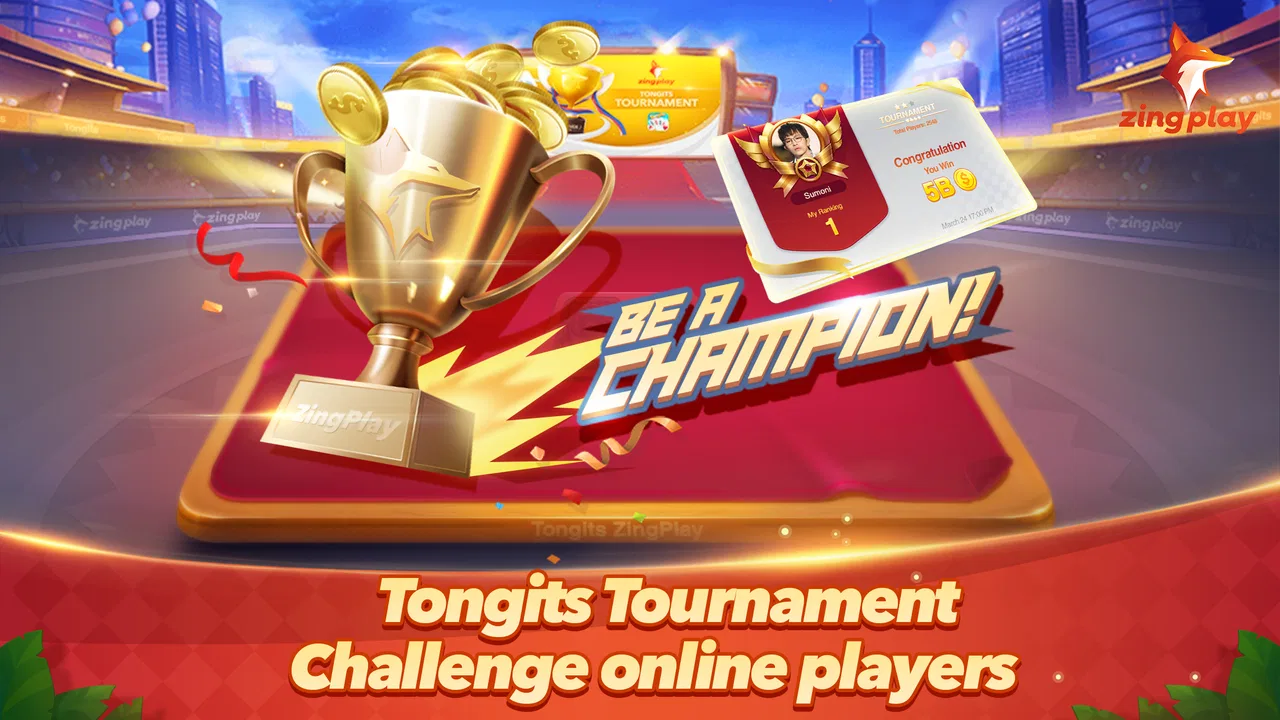
Tongits ZingPlay Global is a mobile card game based on Tongits, a popular Filipino-style rummy game. It allows you to play against other users online, practice your skills, and participate in competitive tables. The app combines traditional rules with a modern interface, animated effects, player profiles, rankings, missions, and virtual rewards designed for short or extended gaming sessions.
02How do you play Tongits ZingPlay Global?
The objective is generally to form valid combinations from your cards, such as sets and sequences, while reducing the value of cards left in your hand. During each turn, you draw and discard cards, deciding whether to build your own combinations or prevent opponents from completing theirs. Rules, scoring, and available modes may vary, so new players should review the in-game tutorial before joining competitive tables.
03Does Tongits ZingPlay Global require an internet connection?
Yes, Tongits ZingPlay Global is primarily an online multiplayer game and normally requires an active internet connection to access tables, synchronize your account, receive rewards, and compete with other players. A stable Wi-Fi or mobile data connection is recommended because interruptions may affect a match. You should also expect the game to use additional data when downloading updates, graphics, or promotional content.
04Is Tongits ZingPlay Global free to download and play?
The game can generally be downloaded and played without an upfront purchase, but it may include optional in-app purchases. These can be used for virtual currency, cosmetic items, special packages, or other advantages depending on the current version and promotions. Virtual items do not represent real cash winnings. Check the store listing and payment settings carefully, especially if children use the device.
05Is Tongits ZingPlay Global suitable for beginners and safe for children?
Beginners can usually start comfortably because the game provides accessible controls, tutorials, and lower-pressure tables before more competitive play. However, the online environment may include chat, advertisements, social interactions, and optional purchases. Age suitability can vary by region and store rating, so parents should review permissions, privacy information, chat features, and spending controls before allowing younger users to install the app.
Pros
- Quick matchmaking makes it easy to start a game anytime.
- Simple card controls are comfortable on both phones and tablets.
- Different table options add variety for casual and regular players.
- Social features let you interact with opponents during matches.
- Regular events can provide extra rewards and reasons to return.
Cons
- Online play depends heavily on a stable internet connection.
- Random card draws can make some matches feel unbalanced.
- Ads may interrupt the experience
- especially for free players.
- In-app purchases can give frequent players access to more resources.
- Chat and player interactions may not suit users seeking a quiet game.

Tongits ZingPlay Global
Gallery